Shinkenchiku Residential Design Competition 2026 Next generation ICT and its potential for Architecture and Urbanism
Theme Next generation ICT and its potential for Architecture and Urbanism
Building upon countless advancements in computers and communications, rapid technological innovations are in full swing. Recent years have seen "generative AI" make its mark almost everywhere we look, from our daily lives to massive industries. These changes are sure to have a significant impact on our lives and cherished values.
What changes will next-generation ICT, everything from communications infrastructure to AI applications, bring to architecture and our cities? We must keep thinking about the future of society, considering both positive and negative influences that ICT may bring.
Toward this end, the notion of different Umwelt "perceptual contexts" may offer insights.
Given that even organisms coexisting in the same immediate environment experience distinct perceptions and timeframes, we must question the limits of human-specific development. How should we consider "the balance between open and closed information"? How are we to incorporate "nonhuman intelligence" into technology? In an era of burgeoning coexistence with ICT, what can we learn from the "internal clocks" of other living things and objects?
Accordingly, we want you to broaden your thinking about next-generation ICT and architecture/cities, and encourage you draw upon insights from the life sciences, information theory and other far-ranging fields, not just architecture and design. We look forward to proposals that redefine ICT not merely as a conventional technology of added convenience, but as something that opens up new possibilities for life, architecture and cities.
Prizes and honors
- PrizesMultiple¥1,000,000
- HonorsMultipleInvitation to address a multidisciplinary event encompassing architecture/urban design, ICT and other fields.
The number of winners and the amount of prize money will be determined by the judge.
Compiled competition proceedings may be published in a+u magazine.
Schedule
- 2026.07.01 (水)Registration opens
- 2026.09.25 (金)Registration closed
- 11月上旬(Early November)Announcement of First-Round Results
- 2026.12.16 (水)Second Round of Judging + Awards Ceremony
- 2027.03.01 (月)Announcement of the winner
Guidelines
Entry and Application
To enter the competition, please first register on the competition website. A registration number will be issued by email after the registration form is properly completed. Each applicant should keep a record of this registration number, as it will be needed for submitting your proposal. Re-registration is required if there is any change in the registered personal information. Also, if the applicant wishes to submit multiple proposals, it is necessary to obtain a registration number for each one.
・No inquiries regarding the registration number will be accepted once the number has been issued.
・Registration is available only through the competition website.
・Use of mobile phone email addresses is not recommended as there might be problems in receiving the registration number.Applicant qualifications
Application is open to both individual and group efforts.
We welcome interdisciplinary collaborations among participants from outside the stated fields of expertise.Submission Requirements
Contents: Site plan, floor plan, elevation, section, perspective drawing, and axonometric drawing at any scale. You are free to include model photographs, detailed drawings, and other diagrams. Your submission should include a descriptive text of your design no more than 250 words in English, or 600 characters in Japanese, in 12-point type or larger. All drawings, illustrations, and texts should be laid out on 2 sheets of A2 (420×594 mm / 16.5×23.5 inches). You may also embed external links.
・File format: PDF
・File size should not exceed 10MB (please combine 2 sheets in a single file)
・The registration number must be used as the name of the PDF file for each design entry (e.g., skc0000.pdf). Please write only your registration number in 30-point or larger font size in the lower right corner of your submission (do not include names or other identifying information).Submission Procedure
Follow the application form at the URL specified in the pre-resistered email, and upload the applicant's information and files.
Please note the file size. Entries outside the regulations will not be considered for judging.Note: The number of emails right before the deadline may overwhelm our internet server, so please do not wait until the last minute to submit your entry. The competition hosts will take no responsibility for submissions that arrive late due to technical issues and will not judge any late submissions.
Announcement of Initial Screening Results
Early November 2026.
In addition to notifying entrants who have passed, we will announce the results on the website.Final Screening
December 16, 2026 in Tokyo.
Applicants who pass the first judging cut-off will be asked to make a video presentation based on their proposal.
The final screening will be held publicly. After presentations of several entries that have passed, Q&A, and judging, recipients of the Grand Prize, Awards of Excellence, and Honorable Mentions will be decided then and there.
Participants in the second round of judging will receive ¥50,000 (tax included) per group to cover transportation costs.Announcement of the Winner
Winner(s) will be announced in the 2027 March issue of SHINKENCHIKU (published on March 1, 2027) and March issue of a+u (published on February 27, 2027), their digital issues, and on the competition website.
Notice
・Copyright of the proposal belongs to the applicant, while the publishing right belongs to Shinkenchiku-sha Co., Ltd.
・Submitted proposals, regardless of the result, may be published on the competition website.
・Questions regarding the competition regulations will not be answered by the hosts. All matters not covered in the regulations listed above are left to the discretion of the entrants.
・Entries must not have been published or otherwise made public previously. Neither the whole nor any part of an entry may infringe upon the copyright of any third party. Do not use images copied from copyrighted materials such as magazines, books, or websites. The entrant shall bear full responsibility for any copyright infringement or other disputes or allegations. If such infringement or other issues are discovered, the organizers reserve the right to revoke the entrant's selection at their discretion.
・The winning entrants will be asked to submit high-resolution digital data for publication.
・All fees associated with submissions must be borne by entrants.
・Please double-check the contents of your submission. You will not be allowed to replace your proposal after submission.
・Please avoid corrupted texts and broken links. Please embed all the linked files.
・Entries will only be accepted if they adhere to all the regulations.
Theme Roundtable Discussion
Umwelt perceptual contexts unpack complex realities
The Shinkenchiku Residential Design Competition 2026 takes as its focus the many implications of on-going and future developments in ICT (information and communications technology) as they affect the fields of architecture and urban design. Toward this end, we have invited a panel of experts from diverse backgrounds to reflect on this extensive subject from multiple perspectives: chairing the competition jury is leading luminary behind the next-generation communication infrastructure IOWN (innovative optical and wireless networks) Katsuhiko Kawazoe (communications), who is joined by Jun Aoki (architecture), Yukiko Shikata (media art), Shin-Ichi Fukuoka (biology) and Yuji Yoshimura (urban studies).
Having previously published (viz. a+u April 2026, p.24) Kawazoe and Yoshimura in conversation about similar issues as they relate to IOWN, hereon we asked our five judges to further discuss various possible ICT scenarios from their own professional perspectives. (a+u)
Generative AI pros and cons
a+u: Please share your thoughts regarding this year’s competition theme.
Katsuhiko Kawazoe (KK): By now, it is unthinkable to discuss next-generation ICT without looking at generative AI. As we all know, generative AI is an incredibly useful tool that readily learns from human-created data on the internet and generates responses in text, image or video formats faster than humanly possible.
Yuji Yoshimura (YY): The pace at which generative AI has evolved and penetrated society these past few years has been tremendous, such that it is becoming common to use it as an aide in daily life. Not so long ago, only a very few programming specialists could utilize AI; even the term “AI” was not widely known among the general public, so this is a remarkable change. Furthermore, as structural changes in industry increasingly demand large-scale semiconductor plants and data centers, we are seeing cities emerge from processes unlike more traditional concentrations of population, transportation and manufacturing. With AI permeating everything from minor daily activities to macro-level urban planning, this “AI era” is conversely testing human wisdom, imagination and creativity.
Shin-Ichi Fukuoka (SF): More immediately, ICT — and generative AI in particular — is rapidly dissolving language barriers. Speech translates instantly, allowing us to understand each other’s native languages. Moreover in recent years, it can assist in interpreting non-verbal information. Take for instance the notion of “affordance” whereby our circumstances naturally prompt actions, letting us intuitively understand how to handle an object simply by looking at it; seeing a doorknob instantly tells us to open the door, seeing a chair tells us to sit. AI can read such ambient features and provide guidance to help people to understand how to interact with spaces and objects.
On the other hand, we hear more and more concern about people treating generative AI as an extension of themselves, becoming dependent on it. Although we know that excessive reliance on technology inevitably weakens our innate personal abilities and awareness, it’s like taking steroids that can both enhance and alter bodily functions. While some basal self will undoubtedly remain inviolate, there’s a trade-off.
Jun Aoki (JA): Likewise in construction, generative AI is now filling a convenient niche — especially with engineering firms overseas — as a “decision support partner.” A trend that progressively risks turning AI into a “deciding contractor,” eventually replacing humans as “decision-makers.” And because generative AI excels at finding optimal solutions under certain given conditions, we ought to be wary that responses may converge and the generated results become mediocre duplications.
Yukiko Shikata (YS): It seems to me that because AI, as the term “artificial intelligence” implies, is a human-authored technology based on human intelligence, it also prioritizes rationality and functionality as championed by recent Western scientific researchers. It alarms me to think that generative AI created on such a basis may eventually worsen disparities in society.
KK: Moreover, there’s a real possibility that crucial information obtained by feeding data into generative AI might concentrate in the hands of only a select few. Prompts input into generative AI are full of givens about what to expect in things to come — that is, preconditions about the future. However, details of such prompts aren’t accessible to everyone. The output may resemble responses to prompts, though as Aoki-san says, they will derive from already known information. If we are to create something truly new, I think we need to work within closed confines to deepen our focus and thus boost the quality of information.
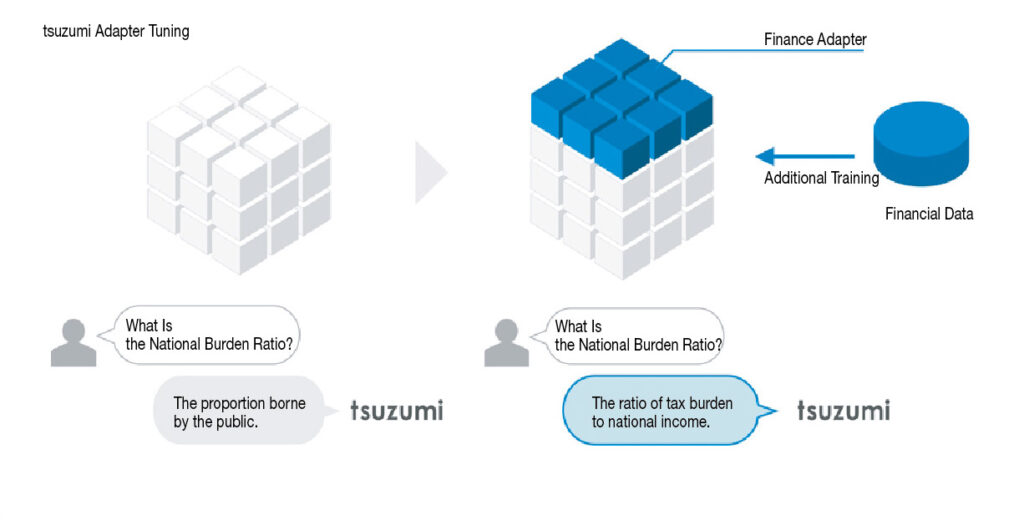
The generative AI model tsuzumi, developed by NTT, is designed to accumulate and utilize the knowledge systems of companies and organizations within a closed environment, with the aim of improving the quality of deliberation and decision-making. Another key feature is Adapter Tuning, which allows domain-specific knowledge to be added for individual organizations and business operations.
Image by NTT Journal.
Engaging next-generation ICT via nonhuman contexts
KK: While I believe we should positively embrace next-generation ICT, including generative AI, we need to be more careful in how we approach things from here on. I believe the key depends on Umwelt, the sphere or context of one’s perceived behavioral environment.
The importance of protecting and nurturing valuable information within closed confines, as I just mentioned, seems quite natural in light of living organisms. Each organism perceives its own behavioral environment, and although they sometimes come into contact with other species, each basically evolves within its own distinct perceptual schema. Up until now, our society has tended to place more emphasis on openness, placing positive value on terms like “open innovation” and “open space.” With the advent of generative AI, however, I think the relative balance between openness and closedness in informatics needs to be re-evaluated along the lines of the Umwelt or perceptual contexts of living organisms.
SF: The idea of Umwelt holds that each living organism constructs its own unique world through its own unique perception. The world we humans experience through our sight and hearing is one such perceptual context. We humans see only visible light within the 400-700 nanometer range, a very limited spectrum; we cannot see ultraviolet light, which insects can. And our hearing is similarly limited; we cannot hear the ultrasound waves that bats emit.
One positive aspect of the changes brought about by generative AI, as suggested earlier, can be seen in how technology expands our Umwelt, the perceptual range in which we humans live. Technology allows us to instantly grasp distant worlds, see things we couldn’t see before, hear things we couldn’t hear before. Umwelt, as Kawazoe-san says, offers us a fresh new perspective by which to think about next-generation ICT.
YS: I myself have been greatly influenced by this idea since the 1990s when the Japanese translation of Jakob von Uexküll’s Umwelt und Innenwelt der Tierre (Umwelt and the Inner World of Animals) came to be widely read here.
Kawazoe-san’s remarks on the relative balance between open and closed also brought to mind the relevant concept of “autopoiesis” proposed in the 1970s by biologists Umberto Maturana and Francisco Varela. They viewed life as a system that maintains itself through continuous self-production. Living cells, for instance, are not bounded by fixed cell membranes, but constantly rebuild by taking in necessary nutrients and expelling unwanted waste. In other words, life is not bounded by walls that completely separate inside from out, but maintains a dynamic interaction with the environment. Accordingly, it may be better to think of information without fixed boundaries, a dynamic that continuously updates in relation to the environment. Even within information space, it becomes important not to view openness and closedness as opposites, but rather to explore how to make them both compatible.
In reference to what I mentioned earlier, about generative AI possibly fostering disparities in the world, here again I feel investigations via nonhuman Umwelt might help correct for this bias, particularly studies in long-neglected areas of nonhuman intelligence. And in fact, I think such trends are already underway; in postwar cybernetics and research since the 1960s into complex systems of the brain and diverse biological phenomena, there has been widespread discussion of “emergence,” how unpredictable behaviors arise from the interaction of simple elements. In other words, we are seeing greater credence in “intelligence” residing not only in human brain awareness, but also emerging from interactions and networks. Then since the 1980s, much celebrated computer simulation and artificial life research made it possible to actually visualize such phenomena. These fields of research brought in technological developments that led to VR (virtual reality) and AI, so that by now the very notion of solitary anthropocentric intelligence has been called into question.
KK: True to what Shikata-san says, AI technologies have up until now been based essentially on anthropocentric data; their capabilities may be said to be roughly equivalent to those of humans. Yet however seemingly omniscient the AI, it cannot solve questions that elude a solely human frame of knowledge — quandaries like “why did the coronavirus mutate specifically as it did?” The answer might not lie in the human sphere, but further afield in the Earth’s environment or the universe at large. Given that AI should learn as well from other than human-generated data, recent developments in generative AI are moving to integrate not only LLMs (large language models) that glean large amounts of text data with a high degree of comprehension and proficiency in natural human language, but also world models that internally simulate physical laws and environmental guidelines to predict and plan future outcomes.
But again, any discussion of nonhuman Umwelt should also consider that internal clocks differ from organism to organism, and that no internal clock is constant in itself. Every biological process from the birth of a cell to death requires a clock, but on what is it based? Genetic codes do not contain any set frequency per se. I believe organisms may well garner information about temporal rhythms from perceptions of their environmental circumstances.
Incidentally, what do all living organisms including humans share, but AI does not? The answer is death.
SF: Life desperately tries to evade the law of increasing entropy, but ultimately cannot resist and meets its end. Which means that life embodies a sense of time, while AI does not have the same lived experience.
Kawazoe-san and I had a lively discussion about time when last we met. External clocks created by humans, such as crystal quartz clocks, are merely oscillators. Our conception of time merely rests on things that generate vibrations, and the entire planet references this as common time. It seems to me that lived time, in the truest sense, probably does not exist in the world described by physics; it exists only in the realm of life.
YS: These days, I get the feeling that our human internal clocks are moving faster too. Information streams so quickly, so pervasively, it seems like everyone is living in a hurry. Right now, for instance, I’m speaking quickly, but I tend to think that people in the past spoke much more slowly. As ICT and generative AI enmesh further into our lives, they may affect our sense of time. Maybe referencing the body clocks of other organisms might be an effective way to regulate our own body clocks.
JA: Given that architecture has always dealt with material constructs, it characteristically changes very slowly compared to most other technologies. Of course, we might conceptually remove time as a factor and move closer to an info-processing service, but essentially I think the significance of architecture probably lies in resisting such trends.
Then again, the slowness of architecture refers not only to the speed of change in buildings themselves, but also to the speed at which we perceive them. Compared to digital forms, physical objects have numerous different aspects replete with large quantities of information in high resolution, all of which humans cannot process at once. Typically, we look selectively for the readings we need and by-pass the rest. However, if a space feels meaningful enough, we might seriously slow our perceptions. Take, for example, quarters whose spatial qualities we don’t understand after just one visit, but discover through continued use. Premised on the various time axes of architecture, cities, ICT and life, we may be able to get a sense of how architecture will play into future world events.
YY: As someone in urban development, I feel that the more digital technology advances, the more important it becomes to slow the pace of the city. In the large-scale pedestrianized superblock projects I have been involved in for a long time in Barcelona, the aim has been to create spaces that accommodate a whole range of transportation modes, not just pedestrians, but also bicycles, micromobile conveyances and automobiles. Eliminating the demarcations between roadway and sidewalk to create a visually flat surface, for example, encourages people by design to be aware of others, to slow down and yield to one another. While on the one hand cities are accelerating — as exemplified by the maglev “bullet train” that will connect Japan’s urban centers, transporting people and goods at ultra-high speeds — increasingly there is also a complementary worldview in which people share spaces at a slower pace. Design can incorporate perspectives for enjoying a slower life, rather than simply creating transit corridors. Design has the power of try to realize a city where people might enjoy smartphones or other digital technology while relaxing.
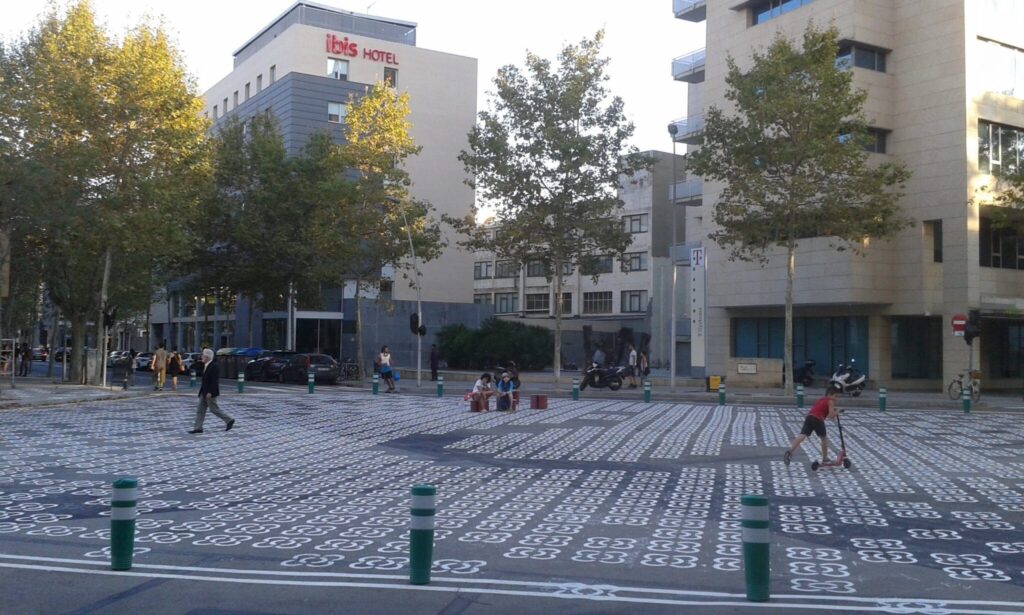
A view of Barcelona’s large-scale pedestrianization. Painted street surfaces and other urban interventions foster a citywide environment that makes walking an enjoyable experience. The public realm is designed to accommodate not only pedestrians but also a range of transport modes, including bicycles and micromobility.
Photo courtesy of Yuji Yoshimura.
Toward creating works for presentation
a+u: Hereon, we would like consider, as concretely as possible, how these ideas you have discussed might be expressed in proposed works for this competition.
JA: Last year, I served as the curator for the Japan Pavilion at the 19th Venice Biennale International Architecture Exhibition, whose overall theme was “Intelligent. Natural. Artificial. Collective.” I chose “In-Between” as our exhibition theme for the Pavilion, the idea being to present a vision of the future with generative AI as a site for dialogue opened “in-between” humans, non-humans and the environment.
In creating the exhibition, I considered non-human intelligence as we just discussed. Looking at communication, say, we humans primarily communicate through language, but plants transmit information in different ways. When aphids infest a tomato plant, it secretes volatile methyl salicylate, which then nearby plants also detect, prompting them to prepare their own defensive responses. I believe such “intelligence” exists not only in humans and plants, but also in man-made objects like buildings and bridges. As in the phrase “material lifespan,” objects also have their own proprietary information, which if exchanged in ways apart from human language, might also be considered to form intelligent relationships.
AI is currently undergoing sudden massive evolution similar to the so-called Cambrian Explosion in biological paleohistory. It promises diverse possibilities. Premised on such various forms of intelligence, we curated the exhibition with the idea that by re-examining the relationship “in-between” humans and artificial intelligence, generative AI systems may also be able to move in different directions than simply dispensing “correct” responses.

Installation view at the Japan Pavilion at the 19th International Architecture Exhibition – La Biennale di Venezia, In-Between. At the center of the gallery is an opening connecting to the floor below. People can engage in dialogue with the “hole,” and these interactions are reflected in a video installation by Asako Fujikura+Takahiro Ohmura.
Photo by Yurika Takano.
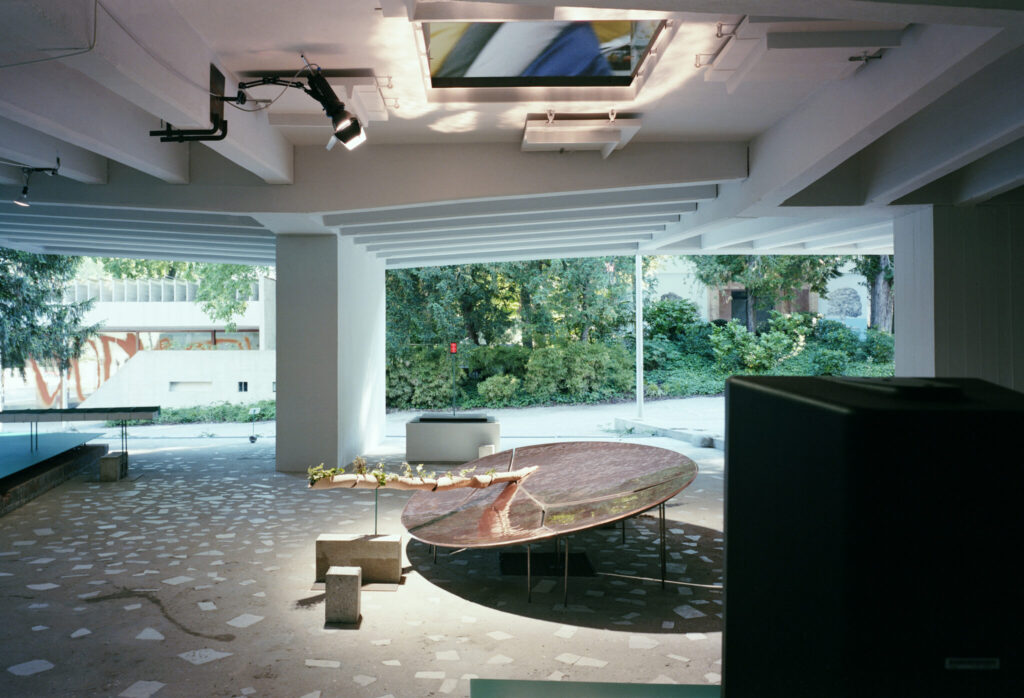
Installation view at the Japan Pavilion at the 19th International Architecture Exhibition – La Biennale di Venezia, In-Between. When the “hole” on the upper floor speaks, a large polished copper dish by SUNAKI reflects light upward toward the floor above.
Photo by Yurika Takano.
YY: In that regard, data may be seen as a language that enables communication between humans and other forms of intelligence. Lately, one new forefront of urban development initiatives launched by residents, businesses and landowners is to use “dashboard” strategies, which involve collecting comprehensive data from a given area and essentially giving it a checkup. In fact, cities may have been murmuring their vital signs all along, but we simply hadn’t been listening. We might even argue that only now have technologies have matured to where we can collect and visualize large-scale data that allows us to hear what cities are saying.
YS: I’m curious to see what sort of messages aspiring architects and artists will set forth about the state of next-generation ICT. New technologies present a world of new possibilities, but they also offer an opportunity to re-examine ourselves and everything around us, the meaning of life, what architecture and cities might be. The fields of design and art are in demand, not only to bring out the benefits of new technologies, but also to help us visualize problems and critically evaluate changes as they arise. Precisely such issues have spurred recent theoretic and practical frameworks of inquiry, such as speculative design for critically forecasting problems and posthumanist design that downplays anthropocentric biases. Such design-specific methodologies may help us confront the new technological frontiers.
Aoki-san, Yoshimura-san, how do you see the role of architects? Especially lately, might ordinary people soon be able to build their own homes using generative AI?
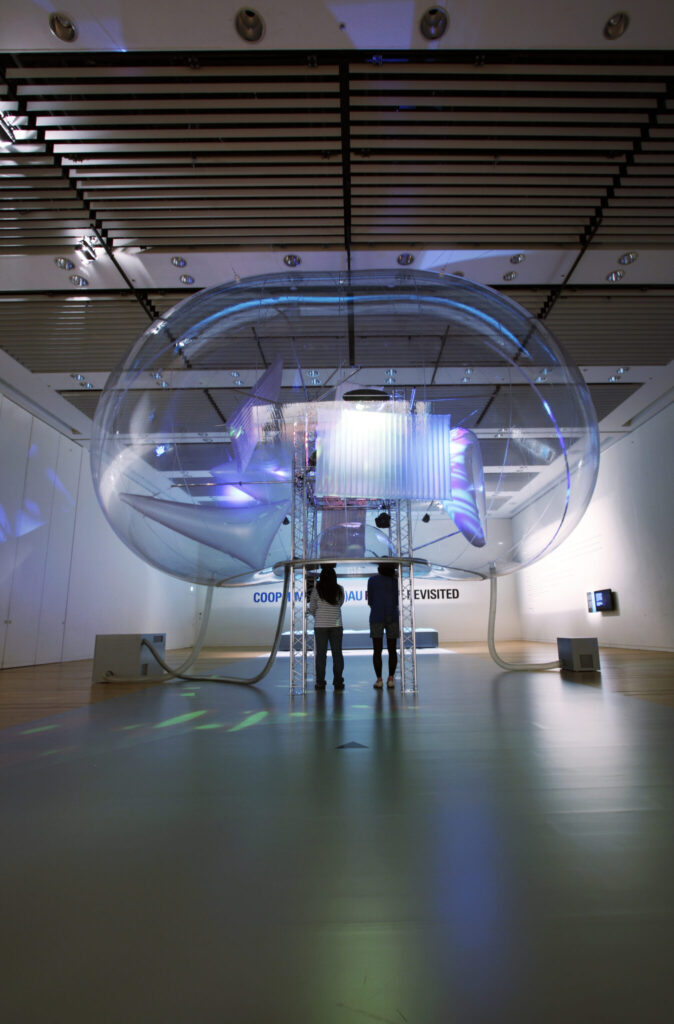
“Astro Balloon 1969 Revisited−Feedback Space” (2008) by COOP HIMMELB(L)AU. Installation view of the exhibition COOP HIMMELB(L)AU: FUTURE REVISITED (19 September–23 December 2009), curated by Yukiko Shikata, at NTT InterCommunication Center [ICC]. An interactive installation that responds in real time to the participant’s heartbeat.
Photo by Tsutomu Takasaki, courtesy of NTT InterCommunication Center [ICC].

“Corpora.prospect” (2009) by doubleNegatives Architecture. Installation view of the exhibition MISSION G: SENSING THE EARTH (16 May 2009–28 February 2010), curated by Yukiko Shikata, at NTT InterCommunication Center [ICC].
A site-specific project in which a virtual “architecture” (Tokyo Opera City) continuously transformed throughout the exhibition in response to real-time measurements of changing weather data.
Photo by Keizo Kioku, courtesy of NTT InterCommunication Center [ICC].
JA: Exactly so. Developments in generative AI will very likely expand possibilities for ordinary people to conceive their own homes and environs. Still, as I cautioned earlier, generative AI tends to produce lowest common denominator solutions. I would like to believe that architects’ expertise lies in not limiting ourselves to extensions of existing values and common sense, but in being able to shift things so as to present new possibilities in built space. Take “affordance,” of which Fukuoka-san spoke earlier. All too often in design fields it is hailed as a catch-all that clues a single, unambiguous action. Affordance ought to be approached as something richer and more multivalent. That is, any given space or apparatus need not invite just one set function, but rather should elicit a variety of interpretations and actions from different people. I believe the role of the architect is not to foreclose possible actions and sensibilities, but rather to open things up.
YY: Like Aoki-san, I too believe that even in these AI data times, the expertise of architects lies in our ability to present spatial possibilities that transcend existing values. While AI and data are often viewed as quick tools for optimization, I see the true essence of an architect’s profession is the ability to present amazingly innovative perspectives.
While architects used to set forth visions for cities, rapid changes in the structure of industries have made cities too vast and complex to grasp or judge solely by human means. This is where big data and AI prove invaluable. Hence I see a growing role for “the architect as data scientist” leveraging data and AI to envision the city through unprecedented ways of using it.
JA: That said, it remains to be seen whether the works submitted for this competition will even resemble “architecture” or “cities” we have known thus far. Looking back at science fiction films since the 1980s, it seems there have been very few definitive new visions of architecture or cities. For our generation, for example, Blade Runner (1982) may have been the last striking image of a future city. Who knows, the future may no longer manifest in the form of new architecture or cities. Quite possibly it’s not the city itself that has changed, but rather our perception of space, as in fact we now live in both physical and virtual realms simultaneously. Physical space no longer occupies center stage in determining the course of the world. In which case, architecture finds itself in a rather precarious position.
Architecture may recede into the background as a mere infrastructural element. All the same, I believe the real question is whether architecture is to become subservient to the digital world and optimized as an interface, or whether it can embrace physicality, weight, chance and other ambiguities, qualities that cannot be captured digitally, and so discover new ways of interacting with the digital world.
YY: The history of urban planning may also be seen as the history of expanding frontiers (viz. a+u September 2024, p.28). The 1920s saw skyscraper construction technology gained momentum in the United States, whereon architects pushed cities vertically skywards. From the 1980s on, waterfronts became a new frontier. Architects have always transformed these new frontiers into material spaces that people physically experience. The current frontier in urban planning is clearly cyberspace. As architects, I believe we have an advantage in expressing cyberspace with material and physical dimensions.
SF: This relates to the earlier discussion about the speed of buildings. We might argue that this current situation calls precisely for an inherent materiality and physicality in architecture. In any case, I think we need proposals about how we are to understand the interplay between next-generation ICT and the unique characteristics of architecture and cities.
KK: Indeed. As a way of unraveling this tension through space, one could imagine proposals such as spaces that enhance the value of closed environments, spaces that incorporate nonhuman intelligence, or spaces that alter our internal clocks.
In this roundtable discussion, we have focused mostly on generative AI, but we hope participants in the competition will take a comprehensive view of next-generation ICT in their proposals. The birth of the automobile in the 20th century is said to have drastically changed the form of architecture and cities; in the 21st century, I believe that generative AI and next-generation ICT as a whole will bring transform our societies. We look forward to in-depth proposals that not only depict rose-colored ICT futures, but also take into account how these technologies will reshape life, architecture and cities.
(This roundtable discussion took place on April 20, 2026)
Jury

Katsuhiko KawazoeJury Chair
Katsuhiko Kawazoe was born in Tokyo in 1961. He received a B.Eng. from Waseda University in 1985 and an M.Eng. from Waseda University in 1987. He joined Nippon Telegraph and Telephone Corporation (NTT) in the same year. In 2009, he received a PhD in Informatics from Kyoto University. He served as Head of the Research and Development Planning Department and Member of the Board of Directors at NTT from 2018, became a Director of NTT Research in 2019, and was appointed Senior Executive Vice President and Head of the Research and Development Planning Department at NTT in 2020. In 2022, he became Representative Member of the Board and Executive Vice President of NTT. He currently serves as Chief Executive Fellow of NTT and President and Chairperson of the IOWN Global Forum.
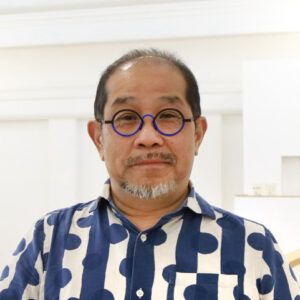
Jun AokiJury Member
Jun Aoki was born in Kanagawa Prefecture in 1956. He received a B.Arch. from the University of Tokyo in 1980 and an M.Arch. from the University of Tokyo in 1982. He worked at Arata Isozaki & Associates from 1982 to 1991 before establishing Jun Aoki & Associates in 1991. The practice was renamed AS Co. Ltd. in 2020. He currently serves as Director of the Kyoto City Museum of Art (Kyoto City KYOCERA Museum of Art) and Professor Emeritus at Tokyo University of the Arts. Photo by Kai Maetani.
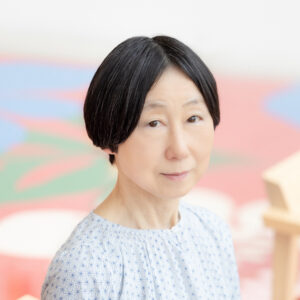
Yukiko ShikataJury Member
Yukiko Shikata was born in Kyoto Prefecture in 1958. She began writing on contemporary art in 1984. She served as Co-Curator of Canon ARTLAB from 1990 to 2001, a Program Committee Member of Yamaguchi Center for Arts and Media [YCAM] from 1998 to 2003, Associate Curator at the Mori Art Museum from 2002 to 2004, and Curator at NTT InterCommunication Center [ICC] from 2004 to 2010. She served as President of the International Association of Art Critics (AICA) Japanese Section from 2022 to 2025. She currently serves as Director of Towada Art Center and Visiting Professor at Tama Art University and Tokyo Zokei University. Photo by Kuniya Oyamada.
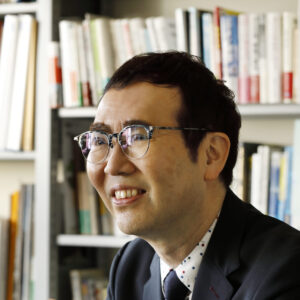
Shin-Ichi FukuokaJury Member
Shin-Ichi Fukuoka is a biologist and author. He is Professor at Aoyama Gakuin University and Visiting Professor at Rockefeller University. He serves as Producer of the theme project “Knowing Life” for Expo 2025 Osaka, Kansai, Japan. His book “Between the inanimate and biological” (Kodansha Gendaishinsho), which received the Suntory Prize for Social Sciences and Humanities, became a bestseller with more than 900,000 copies sold. He has published numerous books that reexamine the question of what life is through his theory of dynamic equilibrium. Photo by Kotaro Kikuta.

Yuji YoshimuraJury Member
Yuji Yoshimura was born in Nagoya, Aichi Prefecture, in 1977. He moved to Spain in 2001 and received a PhD in Computer Science from Pompeu Fabra University. He worked at the Urban Ecology Agency of Barcelona, the Center for Innovation in Transport (CENIT), and as a researcher at the Massachusetts Institute of Technology before joining the Research Center for Advanced Science and Technology at the University of Tokyo as Project Associate Professor in 2019.